
Presses Universitaires de Perpignan
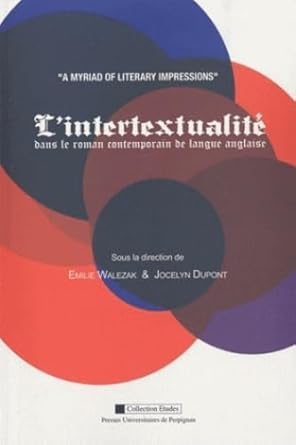
Used book – Intertextuality in the Contemporary Anglophone Novel: "A Myriad of Literary Impressions", Emilie Walezak, Jocelyn Dupont, Collectif
Used book – Intertextuality in the Contemporary Anglophone Novel: "A Myriad of Literary Impressions", Emilie Walezak, Jocelyn Dupont, Collectif
SKU:9782354120665
Retrait gratuit à Perpignan • Port standard offert en France dès 45 € après remises (tarifs jusqu’à 12,90 €)
Couldn't load pickup availability
Plus de 2 400 avis vendeurs : consultez les témoignages déjà publiés sur nos boutiques marketplaces.
Complétez le colis : ajoutez plusieurs petits prix au même panier. Voir les articles sous 5 €.
Over forty years have passed since Julia Kristeva introduced the term "intertextuality" into the French language. This critical concept, inspired by Bakhtin, has given rise to a multiplicity of uses and theories. Some have favored the dialogic and interdiscursive meaning of the term, some its operative nature, while others have seen it as the very locus of literariness. Intertextuality has also been instrumentalized by the structuralist school to serve the triumph of the reader consecrated by the death of the author. Although criticized, debased, and mistreated, intertextuality, even if it is without foundation, is not groundless. Proof of this is its fruitful dynamism in the contemporary Anglophone literary scene of recent decades. Numerous authors such as Peter Ackroyd, Martin Amis, A. S. Byatt, Brian Castro, J. M. Coetzee, Mark Crick, Paul Di Filippo, David Lodge, Patrick McGrath, Vikram Seth, Graham Swift, Louise Welsh, and Jeanette Winterson, whose texts are highlighted in this work, attest to the vitality of writing under influence. Divided between the anxiety of the dissemination of discourses and symbolic anchoring in a plurality of voices, these writers have appropriated the intertextual phenomenon. Thus, intertextuality becomes a key concept allowing for an examination of the contemporary novel and, conversely, the contemporary novel seems to impose a new critical reflection on this notion. Beyond the intertextual work of assimilation and transformation, is there not a specificity of contemporary intertextuality that goes beyond the manipulations of modernist authors like Joyce or Eliot, whose writing predates the advent of the concept by several decades? Does the assumed intertextuality of the contemporary text not force a "refunctionalization," thereby leading to a radical transformation of the literary relationship? The role of the reader within this relationship also deserves to be re-examined. Should the latter still be seen as the primary locus for the actualization of intertexts? In parallel, is the intertext only at the service of dissemination, or should it be considered as a modality of the author-function? It is to all these questions that the authors of the various studies gathered in this collection endeavor to respond.
Livraison & retrait
Livraison & retrait
Retrait gratuit au 11 rue Claude Rouget de l’Isle, 66000 Perpignan.
Pendant le déstockage, le port standard est offert automatiquement en France dès 45 € de panier après remises pour les modes de livraison dont le tarif ne dépasse pas 12,90 €. Les colis plus lourds restent facturés selon le poids.
État & disponibilité
État & disponibilité
Chaque article est décrit et photographié selon son état. La majorité des produits d’occasion sont disponibles en un seul exemplaire.
Le stock est mis à jour sur stanoccasion.com : une vente peut faire disparaître immédiatement la référence.
Retours & assistance
Retours & assistance
Une question avant de commander ? Utilisez le chat de la boutique pour vérifier un détail, l’état d’un article ou les modalités de retrait.
Consultez aussi notre politique de retours et remboursements.
Partager