
Pu Midi
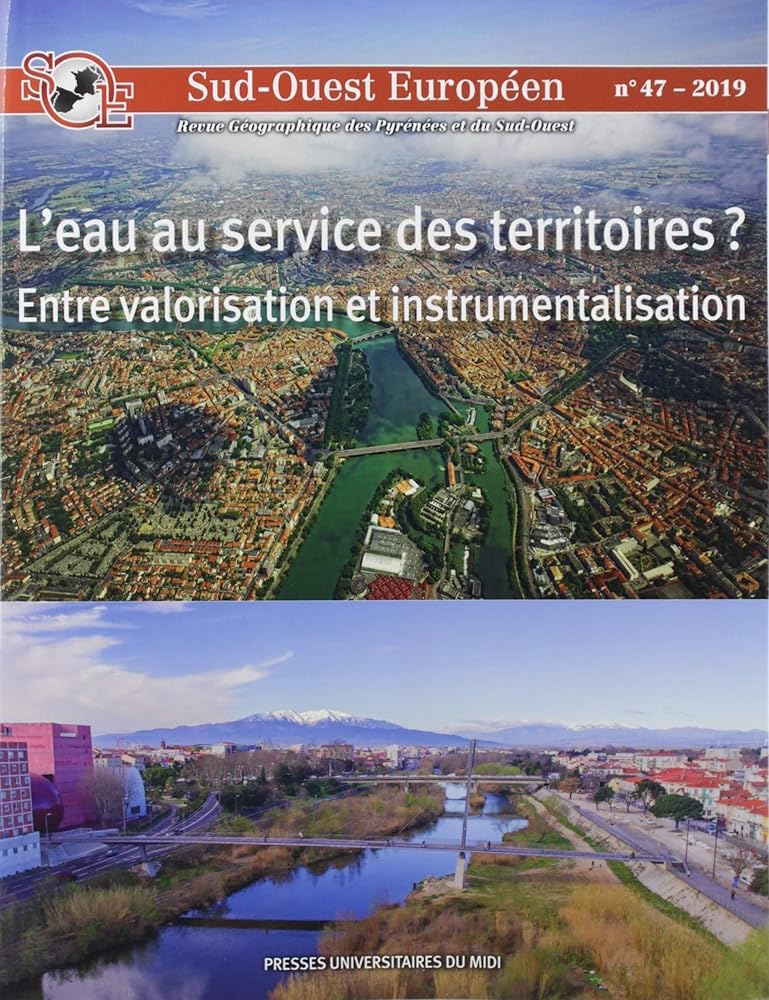
Water for Territories?: Between Valorization and Instrumentalization, Sylvain Rode, Mathilde Gralepois
Water for Territories?: Between Valorization and Instrumentalization, Sylvain Rode, Mathilde Gralepois
SKU:9782810706327
Free pickup in Perpignan
For shippable items, delivery options and fees are shown before payment.
Couldn't load pickup availability
Lire les avis clients de nos boutiques Vinted, Rakuten et Leboncoin
Found other items you like? Add them to the same cart. Browse items under €5
Beyond water management policies (drinking water supply, irrigation, flood prevention, ecological restoration, etc.), water is now an essential element in any territorial project. Its dual nature, both a resource and a risk, means that development must take a stand: should it be kept at a distance by building dikes or isolating its access? Or should it be approached by creating new spatial and social proximities, as well as new forms of economic or ecological enhancement? The challenge is now to consider water and waterways as an integral component of the territory. But this enhancement of water is not always without ambiguity. To what extent does highlighting this element contribute to a territorial marketing approach? To what extent can we say that there is sometimes an instrumentalization of the place of water in projects?
Long dominated by a desire for control, embodied by the construction of technical structures, the relationship with water of many actors has gradually reversed since the 1970s under the influence of the weight of environmental considerations and the recognition of limits in human interventions. This evolution has manifested itself in various fields ranging from stormwater management to flood risk management, or in the field of development and management of waterways, which are now being conserved or even renaturalized. Water then imposes itself as a "territorial resource", to the point of sometimes becoming a central figure in any territorial project, whether it be aesthetic, landscape, ecological or to nurture an imaginary, a sensitivity and a poetics. This highlighting of water and water spaces also contributes to a territorial marketing approach. However, behind an apparent consensus, the enhancement of water in territorial projects is not without ambiguities, reflecting the different, competing and contradictory conceptions that are deployed regarding aquatic environments. Should water be kept at a distance and attempts made to control it through structural developments? Should it be approached and efforts made to live with it by weaving new spatial and social proximities, as well as new forms of economic or ecological enhancement? The answers to these questions have varied over time. But today, the multiple links woven with water represent an opportunity to think about development with water and not against it or without it. The articles in this issue offer a range of analyses at different scales of this use of water in territorial projects, some based on case studies located in the south-west European area, others outside this geographical area, thus making it possible to identify major trends that go beyond local or regional geographical singularities. Two articles complete this thematic issue. The first presents pastoral land associations which, beyond their mountainous origin, could be valuable tools for collective management of private land. The second article remains in the Pyrenees but discusses certain mobility choices present in sparsely populated areas.
9782810706327
Shipping and pickup
Pickup at 11 rue Claude Rouget de l’Isle, 66000 Perpignan. Wait for confirmation that your order is ready before visiting.
Fees depend on cart weight and destination. Review available options and your order total at checkout.
Condition and availability
Read the description and view the photos to check this item's condition and what is included. Many second-hand products are unique. Please contact us before ordering if any detail is missing.
Retours & assistance
Retours & assistance
Une question avant de commander ? Utilisez le chat de la boutique pour vérifier un détail, l’état d’un article ou les modalités de retrait.
Consultez aussi notre politique de retours et remboursements.